
Washington County Deed Instruments
The Washington County Recorder preserves deeds, mortgages, releases, assignments, miscellaneous liens, and federal tax liens for the life of the record. That breadth spans most instruments touching county land. The county page offers no complete document-type menu. The categories below describe common transfer functions, not a verified portal dropdown.
| Deed Type | What It Does | Common Use |
|---|---|---|
| Warranty deed | Conveys the grantor's stated interest with warranties in the instrument | Ordinary arm's-length transfer |
| Quitclaim deed | Conveys whatever interest the grantor holds without broad warranties | Interest cleanup or related-party transfer |
| Trustee or executor deed | Transfers through a named fiduciary role | Trust or estate administration |
| Sheriff's deed | Documents a transfer following a completed court sale | Foreclosure process |
| Tax deed | Documents a transfer after statutory tax-sale steps | Completed tax-deed process |
A deed actually conveys an interest in land. A mortgage or lien only records a claim against it. Before trusting an older index entry, check later assignments, releases, satisfactions, and corrections. Follow-up filings can change what the first document meant. An unreleased mortgage is a lead worth chasing, never proof that a debt still exists.
Two Washington County Remote Routes
Remote research runs through two Fidlar services linked by the Recorder. Tapestry works on a pay-as-you-go basis. Laredo requires an account or subscription arranged with the office. The county states no precise coverage date, image cutover, or per-document charge for either. Tapestry bills separately for searches, data, and documents. Laredo suits recurring account use. Tapestry's entry screen itself displays the payment gate.
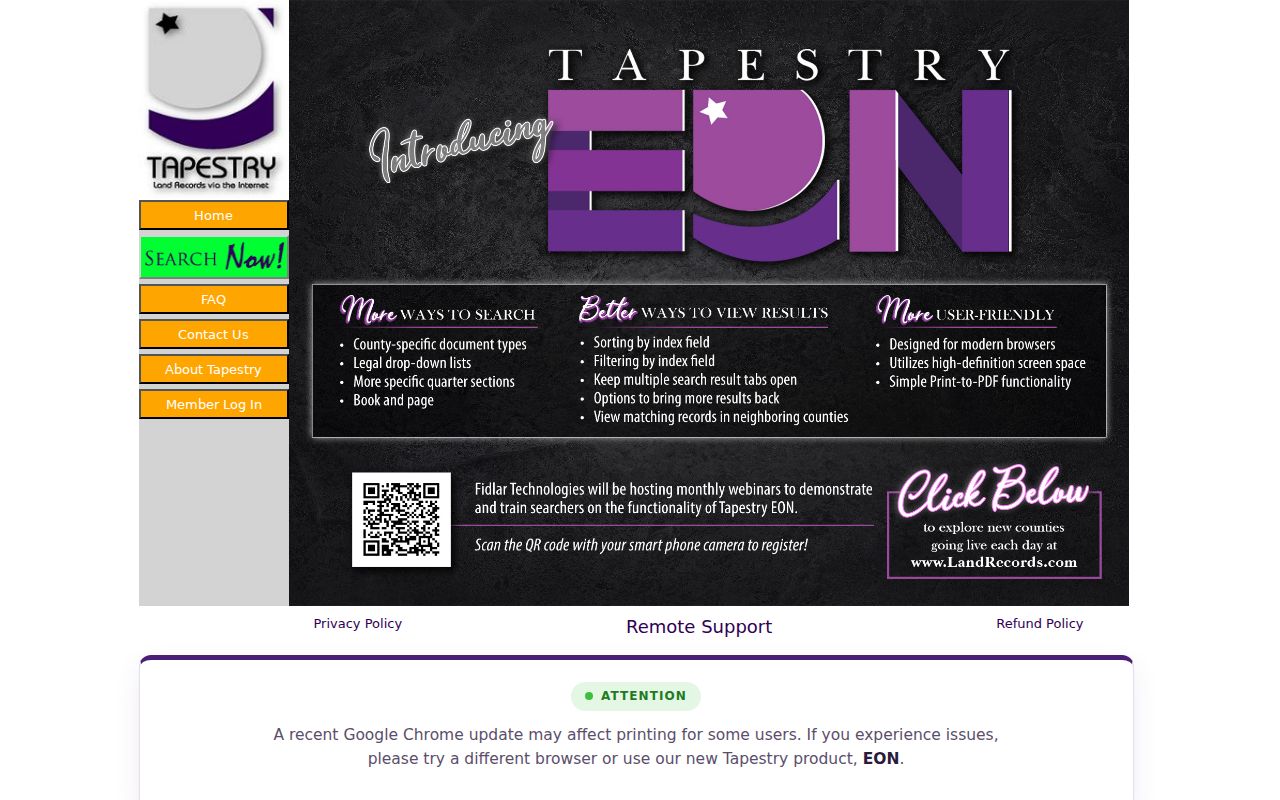
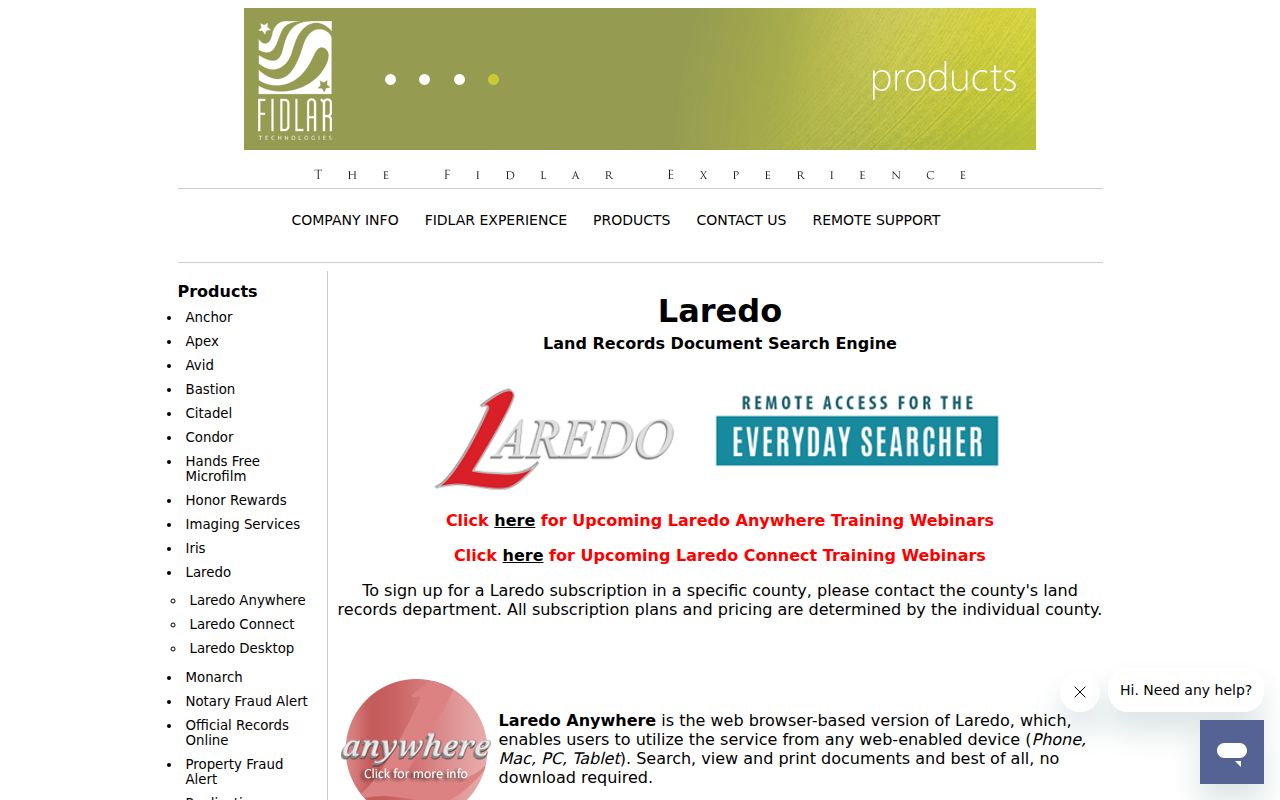
The separate Laredo source describes the recurring account route.
No account is required for everything. The Recorder's office provides photocopies, microfiche, and digital scanned images, according to its official page.
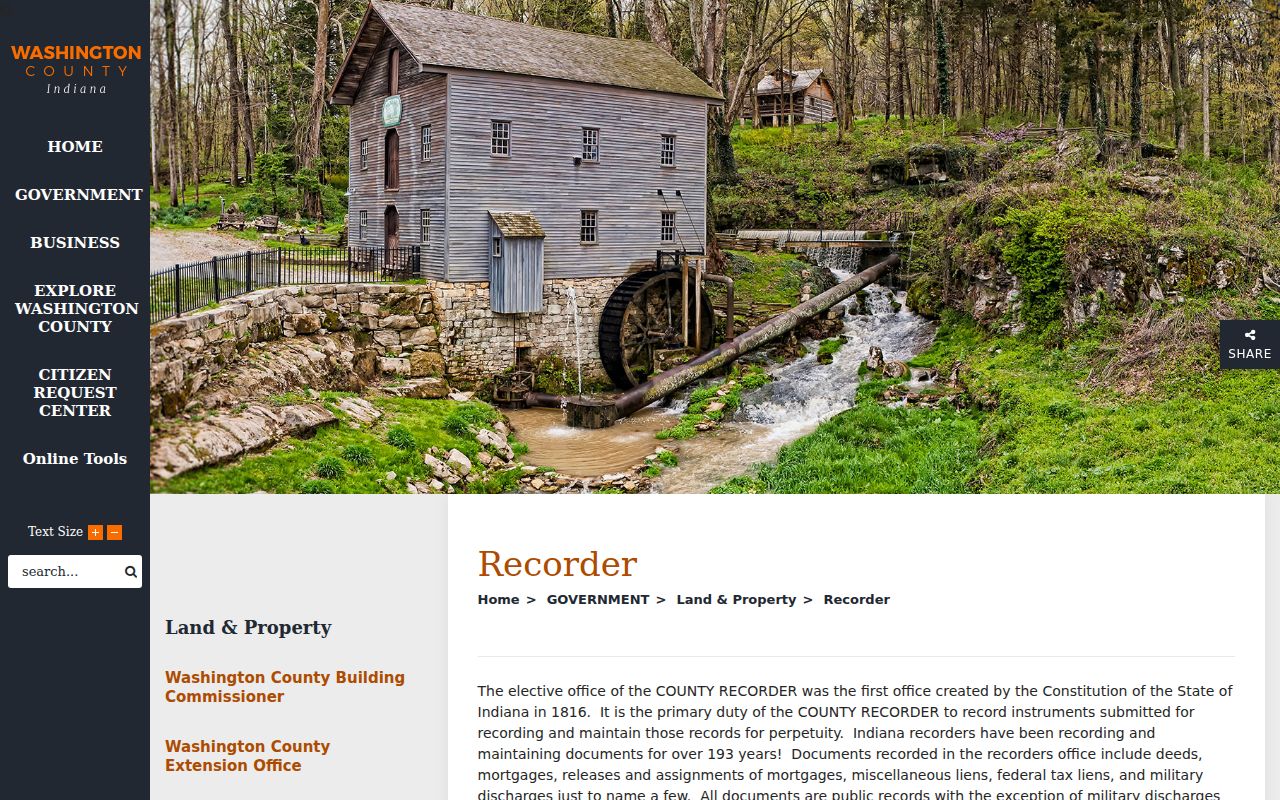
The office can be reached at 812-883-4001, or visited in person at 99 Public Square, Suite 100, in Salem. Walk-in service is available on weekdays from 8:00 a.m. to 4:00 p.m.
Walk Washington County Deeds Backward
Chain research walks backward through names in two roles. Start with the newest deed you know. Read the seller on that instrument, then locate the earlier deed through which that seller acquired the land. Keep repeating while the legal description still matches, and search trusts, estates, entities, and spouses under each period's spellings.
- Find the current owner's purchase deed by searching that owner as grantee.
- Copy the grantor, recording date, instrument or book/page, and full legal-description clue.
- Search that grantor as an earlier grantee, then compare parcel, lot, acreage, and prior references.
- Move to Recorder books, microfiche, or State Library aids when remote coverage ends.
- Grantor
- The party conveying the stated interest.
- Grantee
- The party receiving that interest.
- Chain of title
- The linked sequence of transfers affecting the same land.
- Book/page or instrument number
- A Recorder reference used to retrieve a specific filing.
The Recorder suggests the wildcard pattern Johnson%B%. It means surname, wildcard, first initial, wildcard, no punctuation. Tapestry and Laredo field labels stay behind the payment gate, so expect slight naming differences.
Salem Plat Citations Unlock Deeds
A 2025 legal notice offers a compact local model. Heuser's Subdivision sits at 1106 W Walnut Street, tied to APN 88-24-18-442-022.000-022. The notice also cites Deed Book D-4 page 38. Plat Cabinet Slide 10A completes the set. Together they run from address to plat to deed. Do not assume the deed conveys the whole platted lot; it may reserve an easement or transfer only part. Spring Meadow's 1997 planned-development material, with 31 lots and SR 56 access context, shows why plat and easement records deserve joint reading.
Washington County Mortgages and Releases
Look for filings near the transfer date. Mortgages, assignments, releases, and corrections often cluster around a deed. The borrower, lender, trustee, nominee, or assignee may appear under different roles, so match legal descriptions and recording references rather than names alone. A tax card cannot prove a release.
Federal tax liens and miscellaneous liens also appear among the Recorder's listed records. Court judgments may need a matching cause number. For foreclosure matters, Indiana MyCase can identify a docket. Clerk and Recorder files confirm the rest.
Note: A foreclosure filing or sale notice does not establish that a sale closed or a deed issued.
Historic Washington County Land Books
Older land questions reach beyond the modern index. The Indiana State Library Washington County guide identifies a tract-book index covering 1810 through 1859. Its microfilm finding aid also lists Circuit Court minutes from 1814 through 1818. It also lists probate order books. Those sources bridge gaps when a modern deed search stops.
The Recorder itself has moved through storage generations: books, photocopies, microfiche, and scanned images. Ask whether a cited volume is indexed. Ask whether it is scanned, on microfilm, or available only at the counter. The John Hay Center holds a circa-1870 county and Salem atlas. That map helps interpret an old location. It is not current title evidence.
Recording Alerts, Not Title Monitoring
The Recorder links Property Fraud Alert, a name-based service that emails or calls when a participating recording office indexes a document under a subscribed name. It watches future recordings only. It does not validate a deed, clear a lien, or report every title issue. The county-selection screen serves as the enrollment entry.
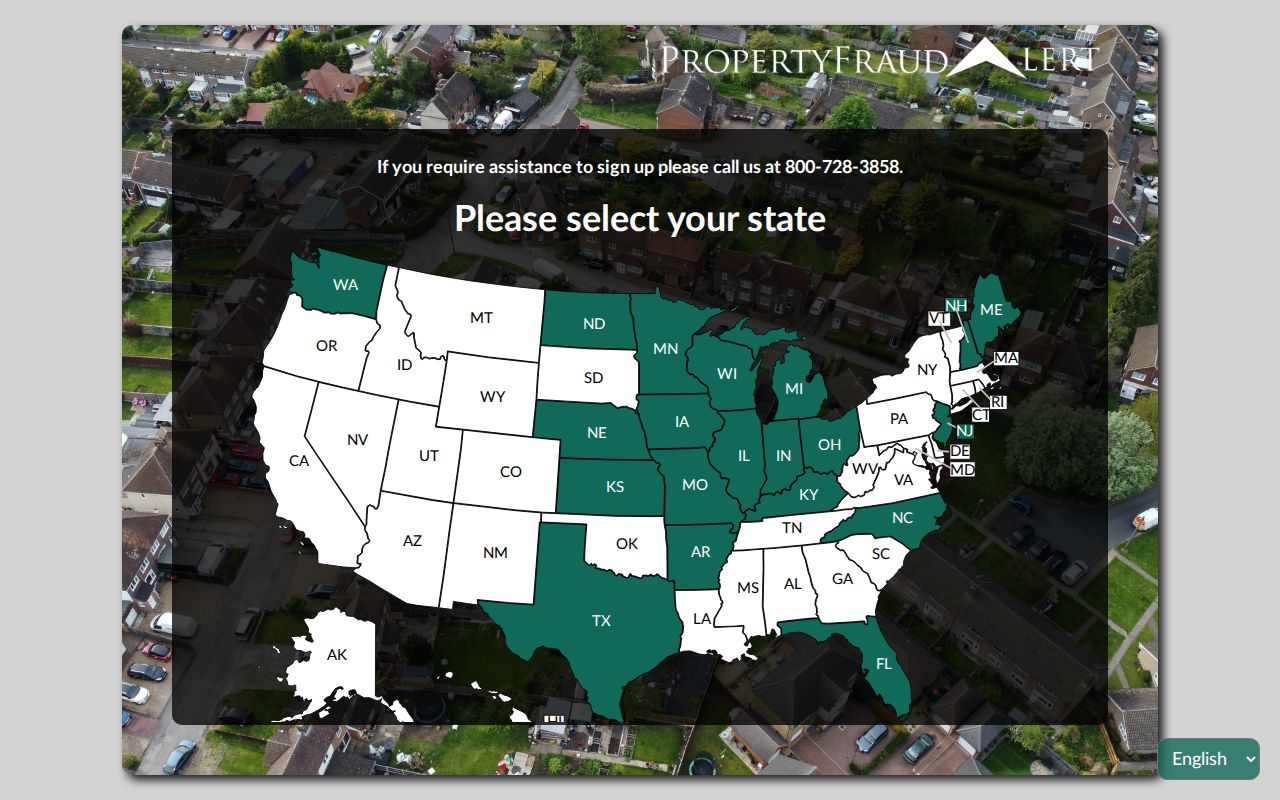
Treat an alert as a prompt, not a verdict. It proves nothing about validity either way. The county keeps recorded documents public, with one exception: DD214 military-discharge records. That limit matters for broad name requests, so ask for the specific real-estate instrument instead of assuming every name-linked filing is open.
Legal Descriptions Control the Match
A street address helps you search. The deed's legal description is the stronger link. Salem subdivision property may carry an addition name, lot, block, plat cabinet, or slide, while rural tracts lean on section, township, range, bearings, acreage, adjoining owners, roads, or creeks. Copy that wording exactly before comparing two transfers.
Today's APN can locate the land. Historic geometry does not always follow current parcel segments, though. A deed may convey part of a lot, reserve an easement, or carve out a tract. The Washington County Surveyor maintains legal survey books, corner records, old aerials, filed surveys, annexation descriptions, and highway or railroad rights-of-way. Those materials can explain a line or a monument.
A shared name proves little. A common address proves no more. Weigh the parties, date, document type, legal description, prior reference, and parcel clue before trusting any match. Tag each chain entry as index-only, image-confirmed, court-confirmed, or survey-confirmed so its weight stays clear.
Distressed Deeds Require Confirmation
Foreclosure and tax-deed research crosses offices. The Washington County Sheriff sales page covers procedure and links to sale notices. MyCase offers public docket clues. The Clerk confirms court documents, and the Recorder confirms whether a sheriff's deed or tax deed was finally recorded.
A 2026 Washington County sheriff-sale notice carried cause number 88C01-2511-MF-000903. That number bridges you into the court file. The notice alone does not prove a completed sale. Match the common address, parcel identifier, legal description, cause number, and final instrument, because postponement, redemption, dismissal, or a later release can change the outcome.
Tax-sale research follows the same discipline. Indiana statutes IC 6-1.1-24 and IC 6-1.1-25 govern tax-sale and tax-deed steps. Washington County posts no current official sale list, so treat an old notice as history rather than present status.
Washington Deed Research Confidence
Weigh every result by its source. An index-only entry proves less than an opened image. An image can still need court confirmation. It may also need a filed survey. That applies when litigation or a boundary conflict changes the story. Keep the instrument with its search terms, retrieval date, and parcel clues.
Watch near-date filings closely. A correction deed or affidavit may fix a name. It may fix a description without creating a new sale. A deed can also reserve an easement or exclude acreage. Read the whole instrument. That habit keeps a short index label from being stretched beyond what it records. The recording date plus instrument reference should ride along with every downloaded image for a reliable later comparison.
Obtain a Washington County Deed Copy
A precise request gets results faster. Include party names, document type, approximate recording date, APN or legal description, and any instrument or book/page number. Ask for a plain image for research. Ask the Recorder what a certified copy requires, and confirm the current fee before ordering.
A narrow written request can also invoke the Indiana Access to Public Records Act, Indiana Code 5-14-3. Seek an existing entry or image with particularity. Complex retrieval takes time. Certification, redaction, and vendor access can each stretch the wait beyond a simple inspection.
Recorded, not guaranteed. Washington County deed records show accepted instruments, not a title opinion. Unrecorded interests, later filings, court orders, and description conflicts can still affect title.
Keep each image with its index data. Note the retrieval date too. A correction deed or affidavit can explain a spelling or description change without marking a new sale, and disputed rights or title call for a qualified Indiana attorney or title professional.